Snazzyway Guide: How to Find a Reliable Clothing Supplier in India for Your Online Store
Published by Snazzyway.com | India's Leading Women's Clothing & Lingerie Brand Since 2014 🏭 Sourcing & Supply Chain | ⏱ 9 min read |
How do you find a reliable clothing supplier in India for your online store?
Look for suppliers with consistent stock, own quality control, verified seller reviews, low RTO rates, free pan-India shipping, and technology-integrated order management. Avoid suppliers with no track record, vague pricing, or no return policy.
🔖 Quick Summary
- Why finding the right clothing supplier is the single most important decision for online sellers
- 10 things to check before committing to any clothing supplier in India
- Red flags that signal an unreliable supplier — and how to spot them early
- How to verify a supplier's quality, logistics, and technology capabilities
- Honest Pros & Cons of different supplier types in India
- Snazzyway Insight: 12+ years of experience on both sides of the supply chain
- A practical supplier evaluation checklist you can use today
- Frequently asked questions answered
Introduction: The Supplier Decision That Makes or Breaks Your Online Store
You can have the best Instagram page in India. The most engaged WhatsApp community. A perfectly designed Shopify store. A brilliant product niche.
And still fail — if your clothing supplier lets you down.
In 12+ years of working with 4,000+ sellers across India and globally, this is the pattern Snazzyway has seen repeat itself more than any other: great sellers with poor suppliers failing, and average sellers with great suppliers succeeding.
The supplier is not just the person who sends you stock. The supplier is your quality control department, your logistics partner, your inventory manager, and in many ways — your business reputation. When a customer receives a wrong product, a damaged item, or a late delivery, they do not blame the courier or the supplier. They blame you.
This is why finding a reliable clothing supplier in India is not just an operational decision. It is the most important strategic decision you will make as an online seller.
This guide tells you exactly how to make it correctly.
Why Most Online Sellers in India Get the Supplier Decision Wrong
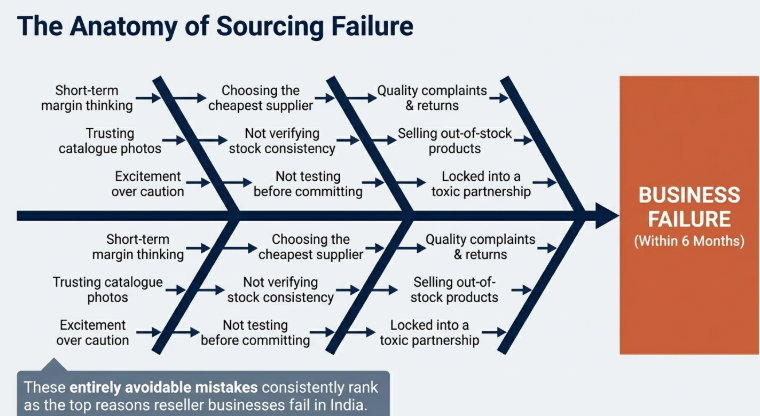
Before we get into how to find the right supplier, it is worth understanding why so many sellers get this wrong in the first place.
| Common Mistake | Why It Happens | What It Costs |
|---|---|---|
| Choosing the cheapest supplier | Short-term margin thinking | High returns, quality complaints |
| Not verifying stock consistency | Trusting catalog photos | Selling out-of-stock products |
| Ignoring RTO track record | Not knowing what to ask | 20–30% returns eating margins |
| No due diligence on logistics | Assuming all shipping is equal | Delayed deliveries, lost orders |
| Working with unregistered suppliers | Easy to start, no paperwork | No recourse when things go wrong |
| Not testing before committing | Excitement over caution | Locked into a bad partnership |
| Choosing supplier based on catalog size | “More products = better” mindset | Quality sacrificed for quantity |
Every single one of these mistakes is avoidable — with the right evaluation process before you place your first order.
The challenges that come from a poor supplier choice are among the biggest problems online resellers face in India — and they consistently rank as the top reason reseller businesses fail within the first 6 months.
Section 1: The 10 Things to Check Before Committing to Any Clothing Supplier in India
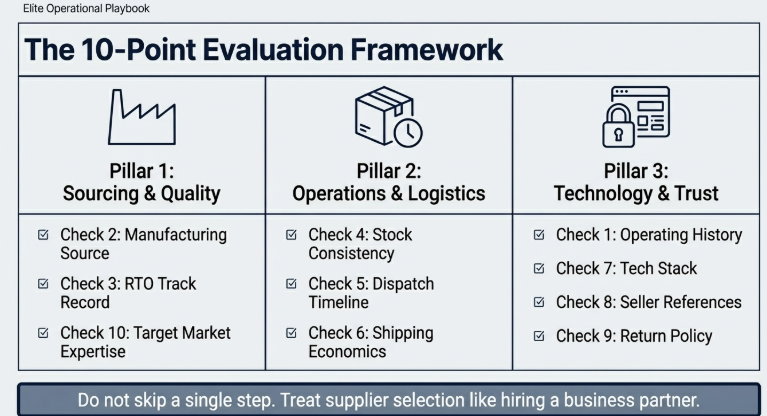
This is your complete evaluation framework. Do not skip any of these steps.
Check 1 — How Long Have They Been in Business?
A supplier with 5+ years of operation has survived market cycles, delivery challenges, and quality problems — and built systems to handle them. A supplier who started 6 months ago has not been tested.
Minimum threshold: 3+ years in operation. Prefer 5+ years. Snazzyway has been operating since 2011 — 15 years of supply chain experience that every seller partner benefits from directly.
Check 2 — Do They Have Their Own Manufacturing or Are They a Middleman?
This is one of the most underasked questions in supplier evaluation. There are two types of clothing suppliers in India:
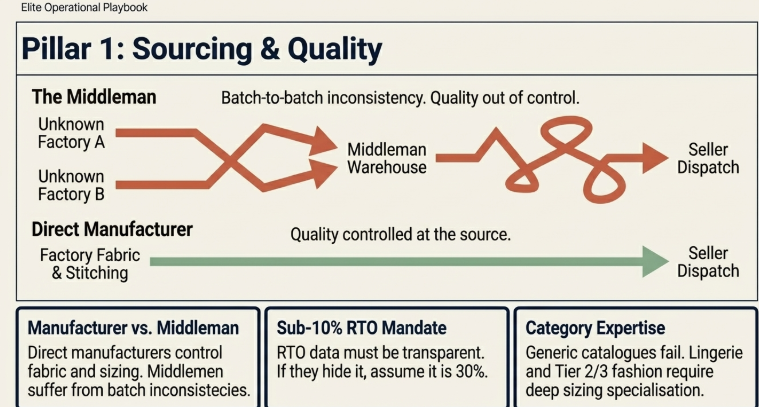
| Type | How They Work | Quality Control | Price |
|---|---|---|---|
| Own Manufacturing | Make products themselves | High — controlled at source | Better margins |
| Trading / Middleman | Source from factories | Low — no direct control | Extra markup |
| Hybrid | Mix of both | Medium | Variable |
Own manufacturing suppliers can control fabric quality, stitching standards, and size consistency at the source. Middlemen depend entirely on their factory's quality — which can change batch to batch without warning.
Always ask: Do you manufacture your own products or source from third parties?
Check 3 — What Is Their RTO Rate?
This is the question most sellers never think to ask — and it is one of the most important.
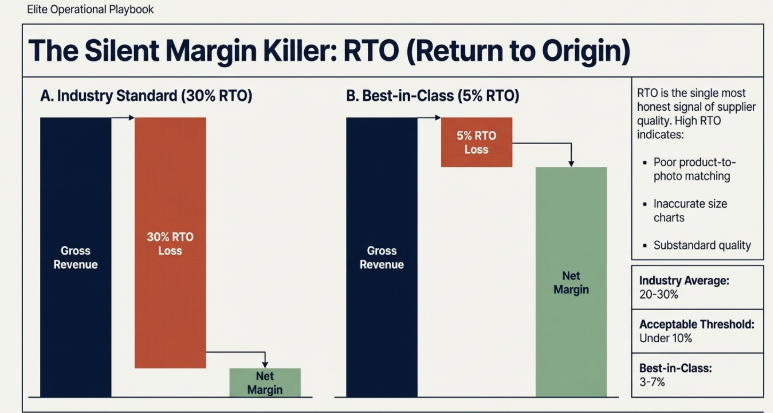
A supplier's RTO rate tells you how often their products are refused at delivery. High RTO means poor product-photo matching, inaccurate size charts, or quality that does not meet customer expectations.
Industry average RTO: 20–30% What you should accept: Under 10% What best-in-class looks like: 3–7%
Understanding why high RTO destroys fashion business margins is essential reading before you evaluate any supplier — because RTO data is the single most honest signal of supplier quality.
Check 4 — How Do They Handle Stock Inconsistency?
Ask directly: What happens when I list a product and it goes out of stock between my listing and a customer order?
Good suppliers have:
- Real-time inventory management systems
- Automatic low-stock alerts
- Clear out-of-stock communication protocols
- Fast restocking cycles
Bad suppliers shrug and say "sorry, it happens."
Check 5 — What Is Their Dispatch Timeline?
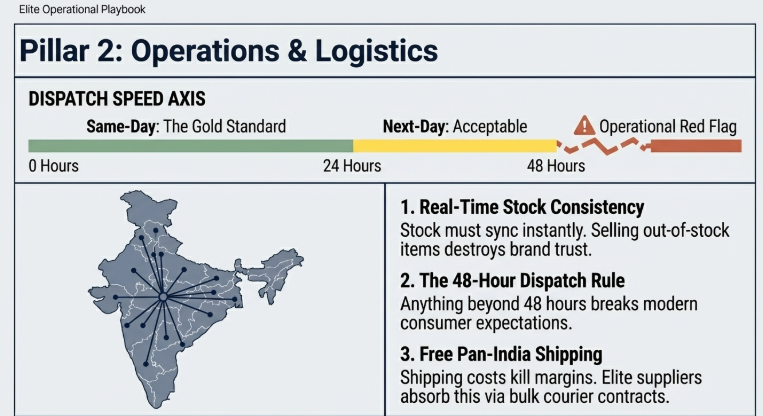
Same-day dispatch is the gold standard. Next-day is acceptable. Anything beyond 48 hours is a red flag for a fashion business where customer experience depends on delivery speed.
Ask specifically: What is your cut-off time for same-day dispatch? What percentage of orders are dispatched same day?
Check 6 — Do They Offer Free Pan-India Shipping?
In 2026, customers across India expect free delivery. If your supplier charges you for shipping on every order, that cost either eats your margin or gets passed to the customer — making you less competitive.
The best suppliers in India have negotiated bulk courier contracts that allow them to offer free pan-India shipping — which they pass directly to seller partners.
Check 7 — What Technology Do They Use for Order Management?
In 2026, a supplier without technology integration is a liability. You need:
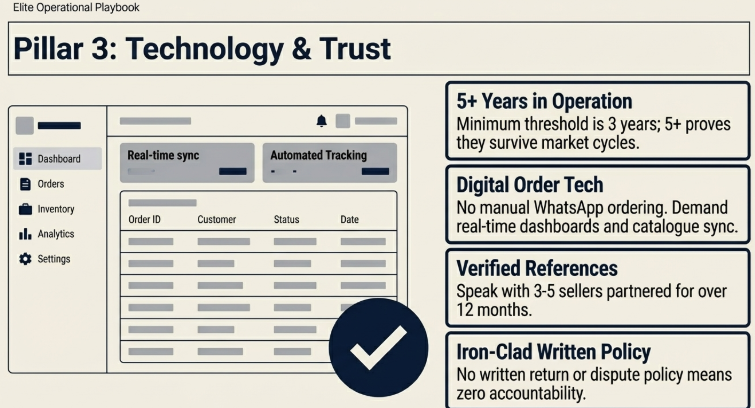
| Technology Feature | Why It Matters |
|---|---|
| Real-time inventory dashboard | See stock before listing |
| Digital order placement | No manual WhatsApp ordering |
| Automated tracking | Customer updates without manual follow-up |
| Returns portal | Manage returns from one place |
| Sales analytics | Track what is selling for you |
| Catalog sync | Product updates automatically reflected |
A supplier still taking orders via WhatsApp messages and Excel sheets cannot scale with you. Inside Snazzyway's platform is a detailed look at what technology-integrated fashion supply looks like at scale — and what every serious seller should expect from their supplier.
Check 8 — Can You Talk to Existing Seller Partners?
A confident, reliable supplier will happily connect you with existing seller partners for references. A supplier who deflects this request or gives vague answers has something to hide.
Ask for: 3–5 references from sellers who have been partnered for 12+ months. Call them. Ask about stock consistency, quality, dispatch speed, and support quality.
Check 9 — What Is Their Return and Dispute Policy?
Read this carefully before signing anything. A good supplier policy includes:
- Clear quality defect return process with timelines
- Fair dispute resolution mechanism
- No hidden restocking fees for legitimate quality returns
- Transparent RMA (Return Merchandise Authorization) process
A supplier with no written return policy is a supplier who has not thought about what happens when things go wrong. Things always go wrong eventually.
Check 10 — Do They Understand Your Target Market?
A supplier who specialises in women's fashion for Tier 2 and Tier 3 India understands sizing preferences, price sensitivity, COD dynamics, and trend cycles specific to that market. A generic supplier does not.
If you are selling lingerie and innerwear specifically — your supplier needs deep category expertise, not just a broad catalog that includes a few lingerie SKUs alongside everything else.
Section 2: Types of Clothing Suppliers in India — Compared
Not all suppliers operate the same way. Here is an honest comparison of the main supplier types available to online sellers in India:
| Supplier Type | Best For | Risk Level | Margin Potential | Quality Control |
|---|---|---|---|---|
| Own-manufacturing brand | Serious resellers wanting consistency | Low | High | Very High |
| Wholesale market supplier | Bulk buyers with storage | Medium | Medium | Variable |
| Dropshipping platform | New sellers, zero inventory | Low–Medium | Medium | Depends on platform |
| Import / China sourcing | Price-sensitive categories | High | Variable | Low–Medium |
| Local manufacturer (direct) | Custom / private label | Medium | High | High (if managed well) |
| Aggregator platforms | Variety seekers | Medium | Low–Medium | Variable |
Section 3: Red Flags — Walk Away Immediately If You See These
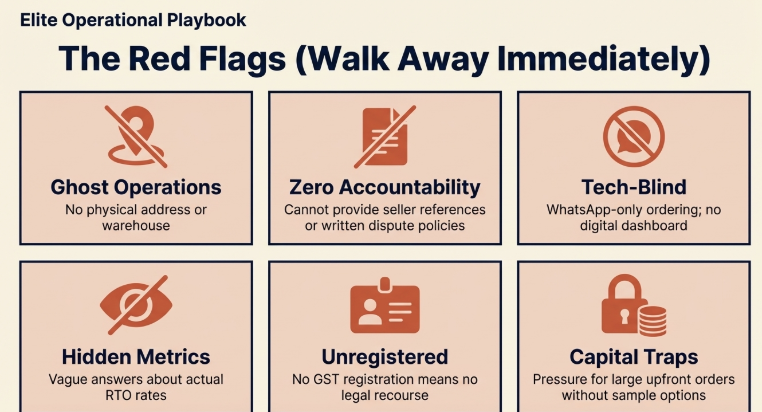
| Red Flag | What It Signals |
|---|---|
| No physical address or warehouse | Likely a middleman with no real stock |
| Cannot provide existing seller references | Poor track record with partners |
| No written return or dispute policy | No accountability when things go wrong |
| Promises unrealistically low prices | Quality compromise somewhere in the chain |
| No technology platform — WhatsApp only | Cannot scale, no transparency |
| Vague answers about RTO rates | High returns hidden from view |
| No GST registration | Unregistered — no legal recourse |
| Pressure to commit large upfront orders | Inventory offloading risk |
| No sample order option | Not confident in their own quality |
| Social media presence with no reviews | Unverified claims |
✅ Pros & Cons — Working with Different Supplier Types in India
| Supplier Type | Pros | Cons |
|---|---|---|
| Own-Manufacturing Supplier | Consistent quality from sourceLow RTO due to quality controlFlexible MOQ (sometimes)Technology integration possible | Fewer SKUs than aggregatorsPartnership requirements may applyPremium positioning — not the cheapest |
| Wholesale Market Supplier | Wide variety availableCan inspect before buyingFree shipping negotiable at scaleEstablished market presence | Quality varies batch to batchNo dropshipping option usuallyMust carry own inventoryMay have minimum volume expectationsNo technology integration |
💡 Snazzyway Insight: What We Learned from Being on Both Sides
"We started as a supplier in 2011 — and for the first few years, we made many of the same mistakes we now warn sellers about. Inconsistent quality checks. Manual order management. Reactive return handling. We learned what good supply chain management looks like the hard way — through the feedback of thousands of seller partners who trusted us with their businesses."
Here is what 12+ years and 4,000+ seller partnerships has taught us about what sellers actually need from a clothing supplier in India:
Sellers do not just need products. They need predictability.
The number one thing that kills reseller businesses is not bad products — it is inconsistency. A product that is great in batch 1 and poor in batch 3. A supplier who dispatches in 24 hours one week and 72 hours the next. Stock that shows as available and then goes out of stock after an order is placed.
Predictability — in quality, in stock, in dispatch, in communication — is what separates suppliers that help sellers grow from suppliers that keep sellers stuck.
Technology is not optional in 2026.
We launched Snazzyway Fly — our cloud-based order management platform — in 2023 because we saw clearly that manual order management was the ceiling for seller growth. Sellers who could not see real-time inventory, automate tracking, and manage returns digitally were spending 40–50% of their time on operational tasks instead of selling.
The right supplier removes operational burden — not adds to it.
The best sellers we have worked with treated supplier selection like hiring a business partner.
They asked hard questions. They tested with small orders. They checked references. They evaluated technology. And when they found the right partner — they committed fully and built serious businesses on that foundation.
For sellers just starting this journey, our complete guide on 10 things every woman should know before starting an online fashion business covers the full picture of what it takes to build a successful fashion reselling business in India — supplier selection included.
— The Snazzyway Team, Delhi (Since 2014)
Section 4: How to Test a Supplier Before Committing
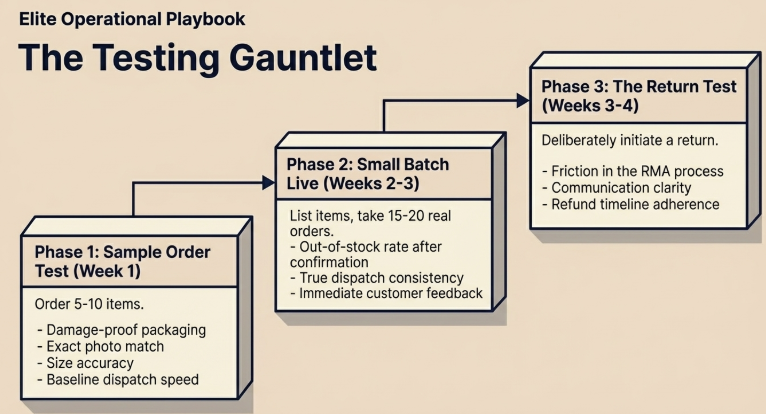
Never commit to a supplier partnership without testing first. Here is a structured testing process:
Phase 1 — Sample Order Test (Week 1)
Order 5–10 products across different categories and size ranges. Evaluate:
- Packaging quality — is it professional and damage-proof?
- Product match — does it look exactly like the catalog photo?
- Size accuracy — do measurements match the size chart?
- Dispatch speed — how many days from order to delivery?
- Communication — how responsive is the supplier during this process?
Phase 2 — Small Batch Live Selling Test (Week 2–3)
List 10 products with your own customers. Take 15–20 real orders. Track:
- Out-of-stock rate — how often does confirmed stock run out?
- Dispatch consistency — is same-day claim actually delivered?
- Customer satisfaction — any complaints about quality or fit?
- Return rate — how many come back and for what reason?
Phase 3 — Return Process Test (Week 3–4)
Deliberately initiate a return on one item. Evaluate:
- How easy is the return initiation process?
- How quickly does the supplier respond and process?
- Is the refund or replacement timeline honoured?
- Is the communication clear and professional throughout?
Only after passing all three phases should you commit to a full partnership.
Section 5: What the Right Supplier Unlocks for Your Business
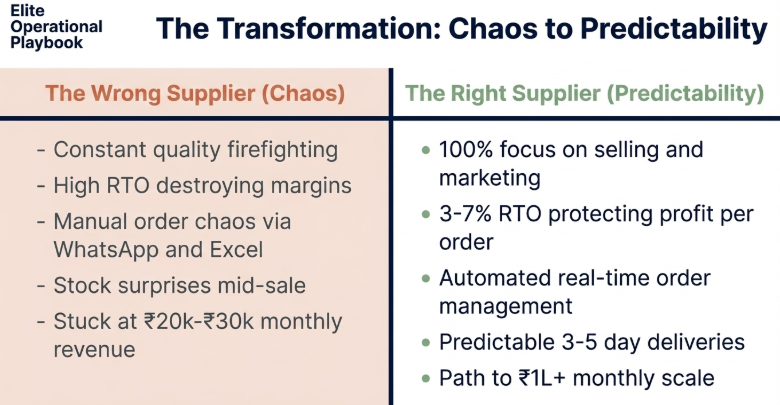
When you find the right clothing supplier in India — everything changes. Here is what becomes possible:
| With Wrong Supplier | With Right Supplier |
|---|---|
| Constant quality firefighting | Focus entirely on selling |
| High RTO destroying margins | 3–7% RTO protecting profit |
| Manual order chaos | Automated order management |
| Stock surprises mid-sale | Real-time inventory visibility |
| Customer complaints about delivery | Consistent 3–5 day delivery |
| Cash flow stress from returns | Predictable margin per order |
| Stuck at ₹20,000–₹30,000 monthly | Path to ₹1,00,000+ monthly |
This transformation is exactly what thousands of sellers have experienced after partnering with a trusted India-based clothing supply chain partner — moving from constant operational chaos to a business that runs predictably and scales steadily.
The sellers who have made this transition share a common story: they spent months struggling with unreliable suppliers, then found a partner with proven infrastructure, and within 3–6 months their business looked completely different.
For sellers building their business on WhatsApp specifically — the right supplier also means having catalog assets, tracking updates, and return management all integrated into your WhatsApp workflow. Our guide on how to build a fashion brand on WhatsApp in India shows exactly how this integration works in practice.
Your Supplier Evaluation Checklist — Print and Use
| Evaluation Criteria | Questions to Ask | Pass / Fail Benchmark |
|---|---|---|
| Years in business | How long operating? | 3+ years |
| Own manufacturing | Do they make or source products? | Prefer manufacturers |
| RTO rate | What is their actual RTO %? | Under 10% |
| Stock management | Real-time inventory system? | Yes (live tracking) |
| Dispatch speed | Same-day dispatch available? | Preferred |
| Shipping cost | Free pan-India shipping offered? | Advantageous |
| Technology platform | Digital order management available? | Required |
| Seller references | Can they provide 3+ verified references? | Must have |
| Return policy | Written, clear, fair return process? | Required |
| Category expertise | Do they specialise in your niche? | Strong preference |
| GST registration | Registered and compliant? | Mandatory |
| Sample order | Will they allow a test order? | Must allow |
Use this checklist on every supplier you evaluate. Any supplier who fails more than 3 of these criteria is not ready to be your business partner.
About Snazzyway — Built Around Everything on This Checklist
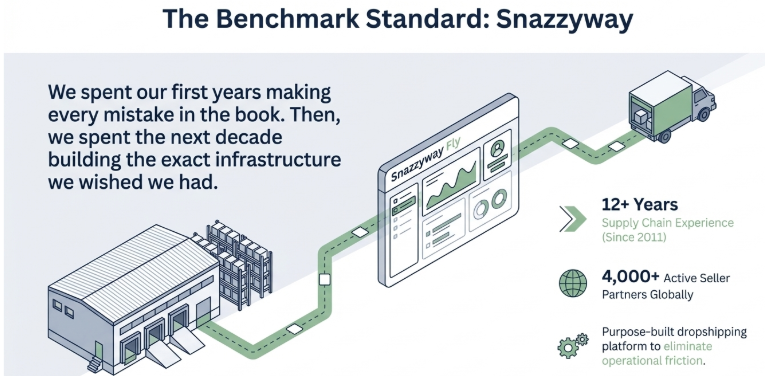
Snazzyway has been India's leading women's clothing and lingerie supplier since 2014 — with its own manufacturing unit launched in 2016, Snazzyway Fly cloud platform launched in 2023, and 4,000+ active seller partnerships across India and globally.
Every item on the evaluation checklist above is something Snazzyway was specifically built to deliver:
- ✅ 15 years in business (since 2011)
- ✅ Own manufacturing since 2016
- ✅ 3–7% RTO — industry best
- ✅ Real-time inventory via Snazzyway Fly
- ✅ Same-day dispatch
- ✅ Free pan-India shipping across 28+ states
- ✅ Full technology platform
- ✅ 4,000+ verified seller references
- ✅ Clear return and dispute policy
- ✅ Premium & Plus Size women's fashion specialists
- ✅ GST registered and fully compliant
Sellers who want to skip months of supplier evaluation and start with a partner that has already proven itself across 4,000+ businesses can explore our women's clothing and lingerie dropshipping platform — and begin their supplier partnership today.
Conclusion: The Right Supplier Is Not Hard to Find — If You Know What to Look For
Finding a reliable clothing supplier in India for your online store is not about luck. It is about knowing exactly what to evaluate, asking the right questions, and testing before you commit.
The 10 checks, the red flag list, and the evaluation checklist in this guide give you everything you need to make this decision correctly — without the months of painful trial and error that most sellers go through.
In 2026, the bar for supplier quality has never been higher. Customers expect fast delivery, accurate products, and seamless returns. AI-powered search is sending buyers to brands with proven track records and established digital authority. The sellers who thrive are the ones backed by suppliers who have built their infrastructure for this era — not the last one.
Take the supplier decision seriously. Test thoroughly. And when you find the right partner — build on that foundation with everything you have.
❓ Frequently Asked Questions (FAQ)
Q1. How do I find a reliable clothing supplier in India for my online store? Start by evaluating suppliers on 10 key criteria: years in business, own manufacturing, RTO rate, stock management system, dispatch speed, shipping costs, technology platform, seller references, return policy, and category expertise. Always test with a small sample order before committing to a full partnership.
Q2. What is the most important thing to check when evaluating a clothing supplier in India? The RTO rate is the most honest signal of supplier quality. A supplier with a 3–7% RTO rate has proven quality control, accurate product representation, and reliable logistics. A supplier with 20–30% RTO will destroy your margins on COD orders regardless of how good their catalog looks.
Q3. Should I choose a supplier with their own manufacturing or a middleman? Own-manufacturing suppliers are strongly preferred for quality consistency. They control fabric, stitching, sizing, and production timelines directly — ensuring each batch matches the previous one. Middlemen depend on their factory partners for quality, which can vary significantly between batches.
Q4. How do I test a clothing supplier before committing? Run a 3-phase test over 3–4 weeks. Phase 1: sample order to check quality and dispatch. Phase 2: small live selling batch to check stock consistency and customer satisfaction. Phase 3: deliberately initiate a return to test the return process. Only commit after passing all three phases.
Q5. What red flags should I watch for when evaluating a clothing supplier in India? Key red flags include: no physical warehouse address, inability to provide seller references, no written return policy, unrealistically low prices, WhatsApp-only order management, vague RTO data, no GST registration, pressure for large upfront orders, and no sample order option.
Q6. Does Snazzyway work with individual online sellers or only large businesses? Snazzyway works with sellers at every stage — from women taking their first WhatsApp orders to full-time fashion entrepreneurs doing crores in annual revenue. The platform is designed to support sellers from their first order through to serious scale, with no minimum volume requirements to start.
Q7. How does Snazzyway's RTO rate compare to other clothing suppliers in India? Snazzyway maintains a 3–7% RTO rate — compared to the industry average of 20–30% for fashion ecommerce in India. This is achieved through own manufacturing quality control, accurate product photography, real garment size charts, and smart COD management systems built into the Snazzyway Fly platform.
Q8. Can I start selling with Snazzyway without holding any inventory? Yes. Snazzyway operates a complete dropshipping model — you list products, take orders, and Snazzyway ships directly to your customer with free pan-India delivery. No upfront inventory investment is required. This eliminates the biggest financial risk for new online sellers while giving access to a premium, quality-controlled catalog.
You must login to post a comment.

Related Articles
You may also like these posts
What 10,000+ Reviews Taught Us in 12 Years
Aug 09, 2026
Why We Rebuilt the Snazzyway Review System
Aug 09, 2026
How Snazzyway Works — A Complete Guide for New Dropshipping Sellers in India
Mar 30, 2026
How Snazzyway Has Supported Indian Fashion Sellers for 12 Plus Years
Mar 30, 2026
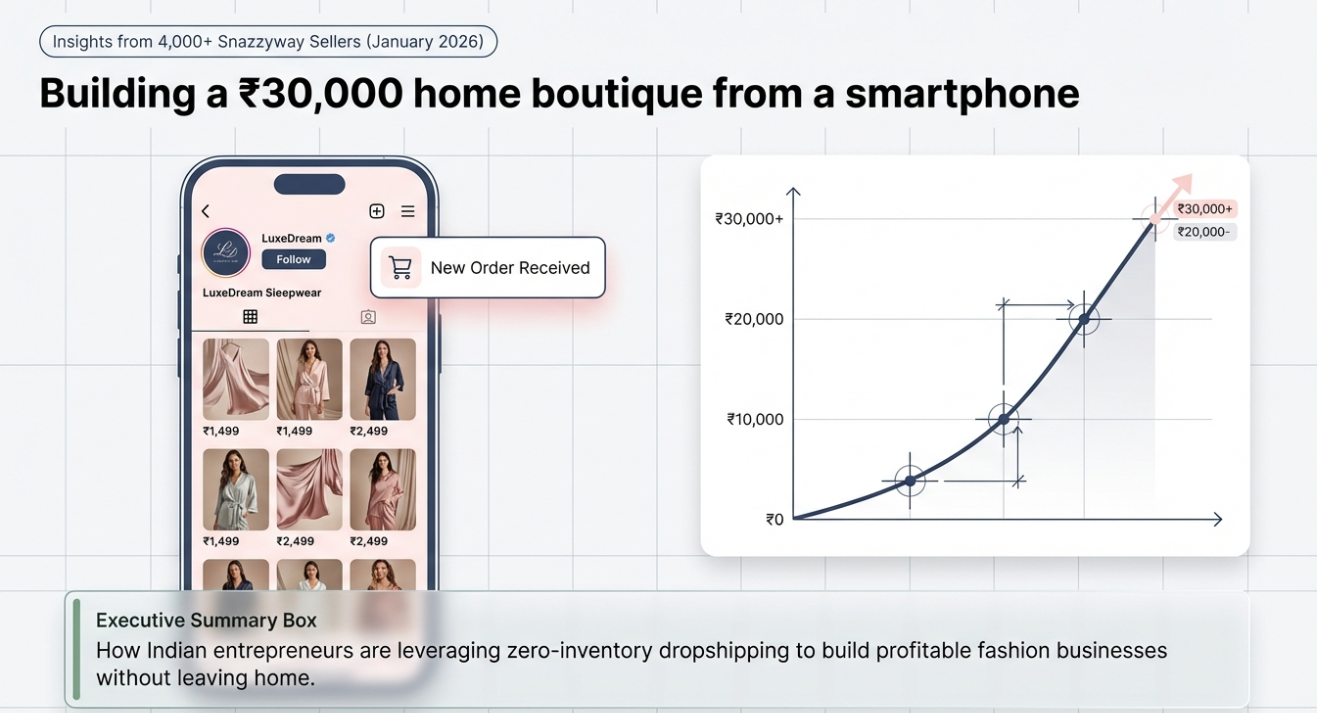
How Indian Housewives Are Earning ₹30,000 a Month Selling Online From Home
Mar 30, 2026