Snazzyway Guide: How to Connect Your Shopify Store with an Indian Fashion Supplier
Published by Snazzyway.com | India's Leading Women's Clothing & Lingerie Brand Since 2014 🛍️ Ecommerce & Technology | ⏱ 9 min read
How do you connect your Shopify store with an Indian fashion supplier?
Choose a supplier with a digital order management platform or API integration, sync your product catalog, set up automated order routing, and ensure they offer pan-India shipping with real-time tracking — so every Shopify order flows directly to fulfillment without manual work.
🔖 Quick Summary
- Why Shopify is one of the best platforms for Indian fashion sellers in 2026
- How to connect your Shopify store with an Indian fashion supplier step by step
- What to look for in a supplier before connecting them to your Shopify store
- Tools and apps that make Shopify-supplier integration seamless
- Honest Pros & Cons of running a Shopify fashion store with an Indian supplier
- Snazzyway Insight: 12+ years of experience supporting Shopify sellers in India
- Common mistakes that break Shopify-supplier connections — and how to avoid them
- Frequently asked questions answered
Introduction: Shopify Is Powerful — But Only If Your Supplier Can Keep Up
Shopify has become one of the most popular platforms for Indian fashion entrepreneurs who want to build their own brand — independent of marketplace algorithms, platform fees, and competitor listings.
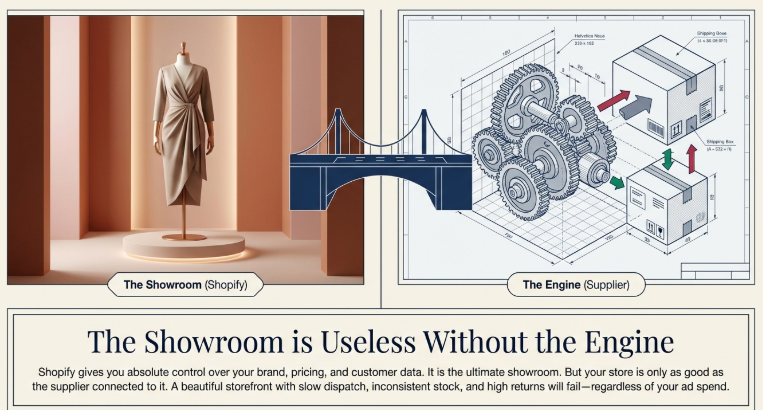
A well-built Shopify store gives you full control over your brand, your customer data, your pricing, and your customer experience. It is the difference between building an asset and renting space on someone else's platform.
But here is the truth that most Shopify tutorials do not tell you:
Your Shopify store is only as good as the supplier connected to it.
A beautiful Shopify store with slow dispatch, inconsistent stock, and high returns will fail — regardless of how good the design is or how much you spend on ads. The supplier is the engine. Shopify is the showroom.
At Snazzyway, we have been supporting fashion sellers — including Shopify store owners — since 2014. With 12+ years of experience and 4,000+ active seller partnerships across India and globally, we have seen exactly what makes Shopify-supplier connections work brilliantly and what makes them break down.
This guide gives you the complete picture — from choosing the right supplier to connecting them to your store to managing the ongoing relationship for maximum growth.
Why Indian Fashion Entrepreneurs Are Choosing Shopify in 2026
| Platform | Best For | Control Level | Brand Building | Fees |
|---|---|---|---|---|
| Shopify | Own brand, full control | Very High | Excellent | Monthly subscription |
| Meesho | Volume, reach | Very Low | Poor | Commission per sale |
| Instagram Shop | Discovery, community | Medium | Good | Meta ad spend |
| Amazon | Scale, trust | Low | Limited | High commission |
| Trust, community | High | Good | Free | |
| Flipkart | Mass market | Low | Poor | High commission |
Shopify wins on brand control and customer ownership — two factors that matter enormously for fashion sellers building long-term businesses. When a customer buys from your Shopify store, they are your customer. Their data is yours. Their repeat purchase comes back to you.
When a customer buys from you on Meesho or Amazon — they are the platform's customer. You have no data, no relationship, and no guarantee they will find you again.
India's fashion ecommerce market — growing 3X faster than offline retail — is increasingly rewarding sellers who own their customer relationships. Shopify is the platform that makes this possible at the most professional level.
Section 1: What to Look for in an Indian Fashion Supplier Before Connecting to Shopify
Before you connect any supplier to your Shopify store, they need to meet a specific set of criteria. A supplier who works fine for WhatsApp selling may not be ready for Shopify integration.
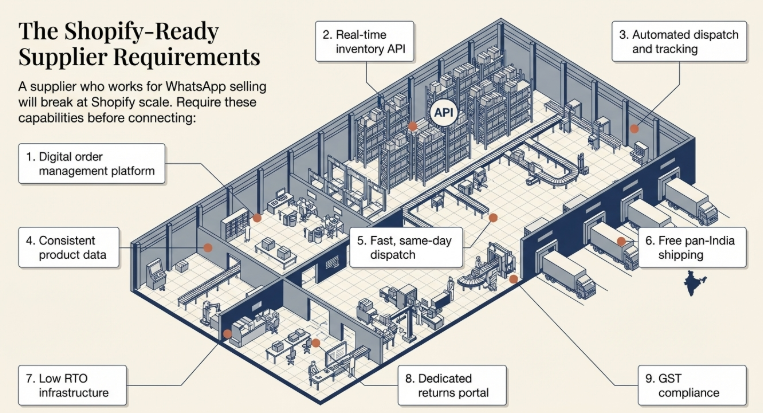
| Requirement | Why It Matters for Shopify |
|---|---|
| Digital order management platform | Manual WhatsApp ordering breaks at Shopify scale |
| Real-time inventory API or feed | Prevents selling out-of-stock products on your store |
| Automated dispatch and tracking | Shopify customers expect tracking links automatically |
| Consistent product data | Title, description, and images must match your listings |
| Fast dispatch (same-day preferred) | Shopify customers compare you to Amazon-level delivery speed |
| Free pan-India shipping | Shopify stores compete heavily on delivery cost — free shipping increases conversions |
| Low RTO infrastructure | Shopify ad spend is wasted if products frequently return |
| Returns portal | Shopify return requests require systematic handling |
| GST compliance | Required for Shopify payment gateway setup in India |
The most critical of these for Shopify specifically is real-time inventory and automated tracking. When a customer places an order on your Shopify store and gets no tracking update for 3 days — they file a dispute and leave a bad review. This happens consistently with suppliers who have not built technology for Shopify-level customer expectations.
For a complete framework on evaluating Indian clothing suppliers before committing to any integration, our detailed guide on how to find a reliable clothing supplier in India for your online store covers the full 10-point evaluation checklist.
Section 2: Step-by-Step — How to Connect Your Shopify Store with an Indian Fashion Supplier
Step 1 — Set Up Your Shopify Store Correctly
Before connecting any supplier, your Shopify store needs to be properly configured:
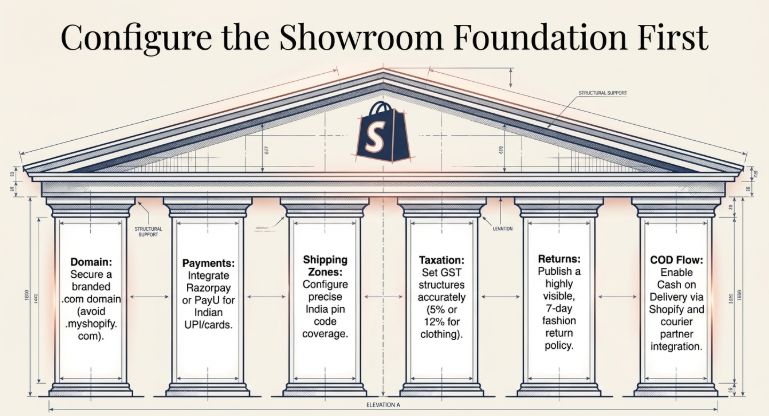
| Shopify Setup Element | What to Do |
|---|---|
| Store domain | Use a branded .com domain — avoid mystore.myshopify.com |
| Payment gateway | Set up Razorpay or PayU for Indian payments + international card support |
| Shipping zones | Configure India shipping zones with accurate pin code coverage |
| Tax settings | Set up GST correctly — 5% or 12% for clothing categories |
| Return policy page | Keep a clear, visible return policy to build customer trust |
| COD setup | Enable COD via Shopify + integrate with courier partners |
A Shopify store that is not set up correctly will create problems even with a perfect supplier. Get the foundation right before you connect anything.
Step 2 — Choose Your Integration Method
There are three ways to connect an Indian fashion supplier to your Shopify store:
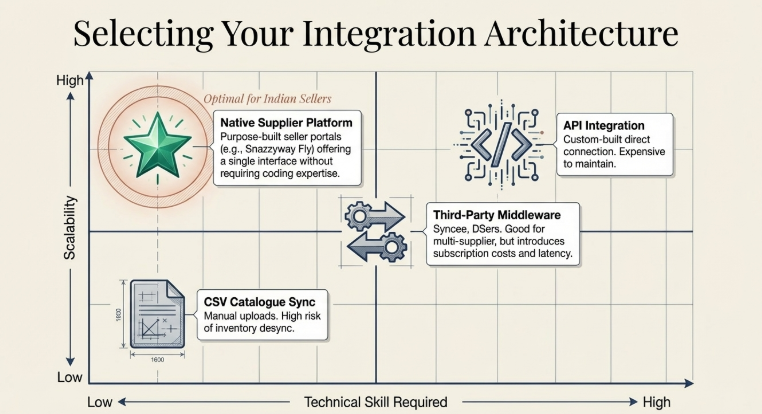
| Integration Method | How It Works | Technical Skill Needed | Best For |
|---|---|---|---|
| Supplier's own platform | Supplier provides a Shopify app or dedicated portal | Low | Most fashion suppliers |
| CSV catalog sync | Manually upload supplier catalog as products | Low–Medium | Smaller catalogs |
| API integration | Direct connection between supplier system and Shopify | High | Large-scale operations |
| Third-party middleware | Use tools like Syncee, DSers, or custom apps | Medium | Multi-supplier setups |
For most Indian fashion sellers starting out — the supplier's own platform is the simplest and most reliable method. A supplier with a purpose-built seller portal (like Snazzyway Fly) gives you a single interface to manage catalog, orders, tracking, and returns — without needing technical expertise.
Step 3 — Sync Your Product Catalog
Once your integration method is chosen:
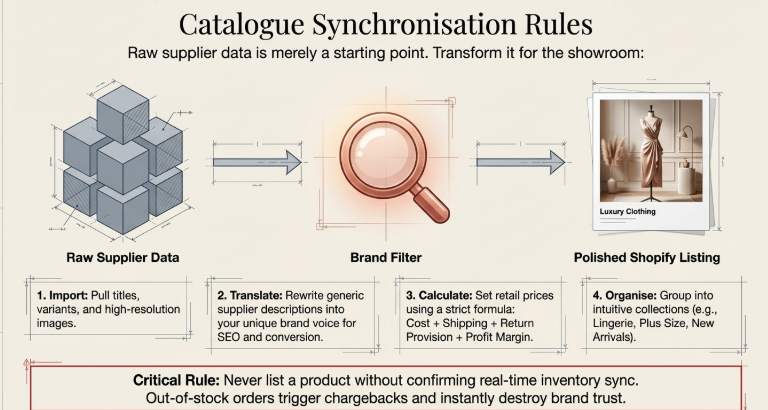
- Import supplier product data — titles, descriptions, images, variants
- Customise product descriptions in your brand voice — do not use generic supplier copy
- Set your retail prices with correct margin — cost + shipping + return provision + profit
- Organise products into collections — Lingerie, Nightwear, Plus Size, New Arrivals
- Set inventory tracking to update automatically from supplier feed
Critical: Never list a product on Shopify without confirming it is currently in stock with your supplier. Selling an out-of-stock product on Shopify triggers immediate customer dissatisfaction and potential chargeback.
Step 4 — Set Up Automated Order Routing
When a customer places an order on your Shopify store — that order should flow to your supplier automatically or with minimum manual steps:
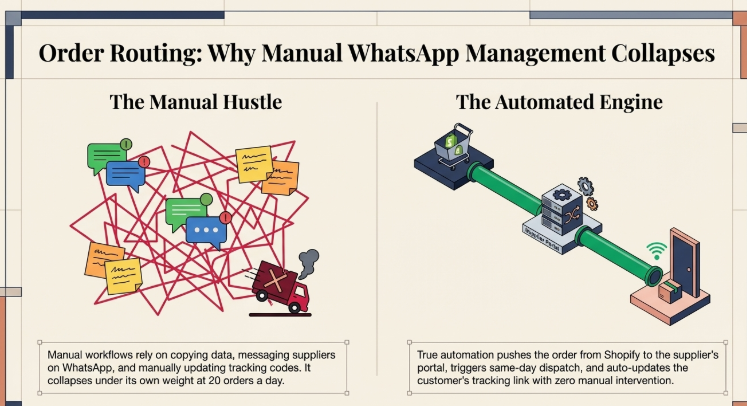
Ideal order flow: Customer orders on Shopify → Order automatically appears in supplier portal → Supplier dispatches same day → Tracking number automatically updated in Shopify → Customer receives tracking notification → Delivery completed
Manual order flow (avoid): Customer orders on Shopify → You manually copy order details → Send to supplier via WhatsApp → Supplier confirms via WhatsApp → You manually update tracking → Customer has no automatic updates
The difference between these two flows is the difference between a scalable Shopify business and a manual hustle that breaks at 20 orders per day.
Step 5 — Configure Returns and Customer Service
Set up your Shopify store's return flow to match your supplier's return policy:
- Set return window clearly on your website — 7 days is standard for fashion
- Create a return request form on Shopify
- Connect return requests to your supplier's RMA process
- Set up refund automation for prepaid orders once return is confirmed
- For COD orders — establish clear policy on how refunds are processed
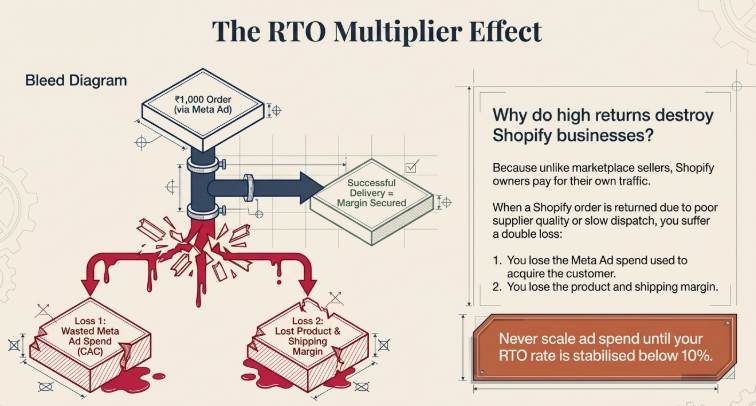
Understanding why high RTO destroys fashion business margins is essential for Shopify fashion sellers — because returns on a Shopify store with paid traffic are doubly damaging: you lose the ad spend AND the margin.
Section 3: Shopify Apps That Help Indian Fashion Sellers
| App | What It Does | Cost | Best For |
|---|---|---|---|
| Razorpay for Shopify | Indian payment gateway — UPI, cards, COD | Free + transaction fee | All Indian stores |
| Shiprocket for Shopify | Multi-courier shipping management in India | ₹999–₹2,999/month | Sellers managing own shipping |
| Syncee | Connect supplier catalogs to Shopify | $29–$99/month | Multi-supplier management |
| DSers | Order management and supplier sync | Free–$499/month | Dropshipping stores |
| Judge.me | Product reviews and trust building | Free–$15/month | All Shopify stores |
| WhatsApp by SuperLemon | WhatsApp integration for order updates | Free–₹999/month | Indian customer communication |
| ReConvert | Post-purchase upsell and cross-sell | $4.99–$14.99/month | Increasing average order value |
| Loox | Photo reviews from customers | $9.99–$29.99/month | Fashion visual trust building |
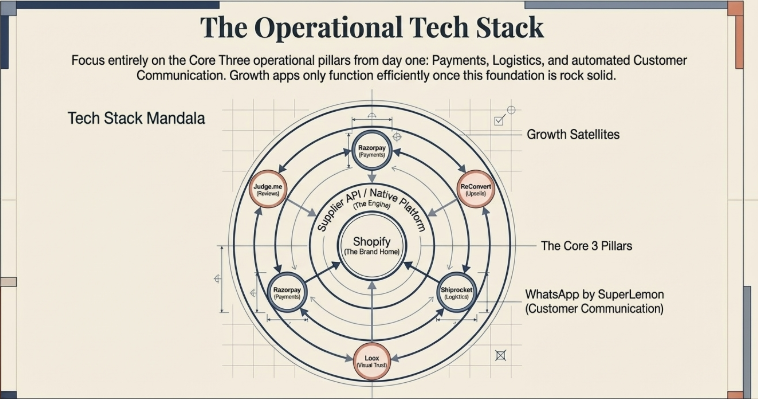
For Indian fashion sellers specifically — Razorpay + Shiprocket + WhatsApp integration is the most important app stack to set up from day one. These three cover payments, logistics, and customer communication — the three operational pillars of a Shopify fashion store in India.
✅ Pros & Cons — Running a Shopify Fashion Store with an Indian Supplier
| ✅ Pros | ⚠️ Cons to Prepare For |
|---|---|
| Full brand ownership and control | Monthly Shopify subscription cost |
| Customer data belongs to you | Requires more setup than marketplace selling |
| No competitor listings on your store | Traffic must be driven — not organic like Meesho |
| Better margins than marketplace commissions | Customer acquisition cost via ads can be high |
| Professional brand image builds trust | Returns management more complex than marketplace |
| Shopify analytics gives deep business insights | COD setup requires additional courier integration |
| Scalable — no listing limits | Technical setup can be overwhelming for beginners |
| International selling possible | Needs consistent content and marketing effort |
💡 Snazzyway Insight: What Shopify Sellers in India Get Wrong Most Often
"We have worked with Shopify fashion sellers since the early days of Shopify India adoption. The sellers who succeed on Shopify are not necessarily the most technical — they are the ones who got their supplier connection right and then focused all their energy on marketing and customer experience."
Here is what 12+ years of supporting fashion sellers — including hundreds of Shopify store owners — has taught us:
The biggest Shopify mistake: spending on ads before fixing the supplier connection.
We have seen sellers spend ₹50,000 on Facebook and Instagram ads to drive traffic to a Shopify store — only to have 25% of orders returned because the supplier's product did not match the listing photos. Every rupee of ad spend is multiplied by RTO losses when the supply chain is not right.
Fix the supplier first. Run a 30-day test with organic traffic. Only scale with paid ads once your RTO rate is under 10% and your customer satisfaction is consistently high.
The second biggest mistake: manual order management at Shopify scale.
Manual order management works at 5 orders per day. It breaks at 20. It collapses at 50. Shopify's power is automation — but that automation requires a supplier with the technology to match. A supplier who takes orders via WhatsApp messages cannot integrate with Shopify's automated order flow.
This is exactly why the platform Snazzyway built for its seller partners — Snazzyway Fly — was designed from the ground up for automated order management. Real-time inventory, one-click order placement, automated tracking — all the infrastructure Shopify sellers need from their supplier side.
The third insight: Shopify works best as part of a multi-channel strategy.
The most successful fashion sellers we work with use Shopify as their brand home — the destination where loyal customers return and where brand identity lives. But they drive initial discovery through Instagram, WhatsApp communities, and occasionally Meesho. Shopify converts and retains. Other platforms discover and acquire.
Understanding this multi-channel approach is also explored in our guide on 10 things every woman should know before starting an online fashion business — including how to think about platform selection strategically from day one.
— The Snazzyway Team, Delhi (Since 2014)
Section 4: Common Mistakes That Break Shopify-Supplier Connections
| Mistake | What Happens | How to Avoid |
|---|---|---|
| Not testing supplier before going live | First real customers get a bad experience | Always run a 30-day test before running ads |
| Listing products without stock confirmation | Selling unavailable products | Use real-time inventory sync only |
| Using supplier's generic product descriptions | Poor SEO, low conversion | Rewrite all descriptions in your brand voice |
| Not setting up COD correctly | Missing majority of Indian orders | Configure COD from day one |
| Ignoring returns setup | Customer disputes and chargebacks | Set up return flow before the first sale |
| Single supplier dependency | One stock-out can halt the entire store | Evaluate a backup supplier starting from month 3 |
| Not tracking RTO by product | Cannot identify problem SKUs | Review RTO data weekly at product level |
| Skipping customer communication setup | No order updates leads to customer anxiety | Set up WhatsApp + email notifications |
The biggest challenges online resellers face in India are amplified on Shopify because customer expectations are higher — they are buying from what looks like a professional brand, not a marketplace seller. Every operational failure is more visible and more damaging to brand reputation.
Section 5: How to Drive Traffic to Your Shopify Fashion Store in India
A connected supplier and a working store is the foundation. Traffic is what makes it generate revenue.
| Traffic Source | Cost | Speed | Quality | Best For |
|---|---|---|---|---|
| Instagram Reels + organic | Free | Slow build | High | Brand discovery |
| WhatsApp community | Free | Medium | Very High | Repeat customers |
| Meta (Facebook/Instagram) ads | ₹5,000–₹50,000+/month | Fast | Medium | Scaling |
| Google Shopping ads | ₹3,000–₹30,000+/month | Fast | High | High-intent buyers |
| Influencer collaborations | ₹2,000–₹20,000/post | Medium | Medium–High | Brand awareness |
| SEO (product + blog content) | Free (time investment) | Slow build | Very High | Long-term growth |
| WhatsApp broadcast campaigns | Free–low cost | Fast | Very High | Existing customers |
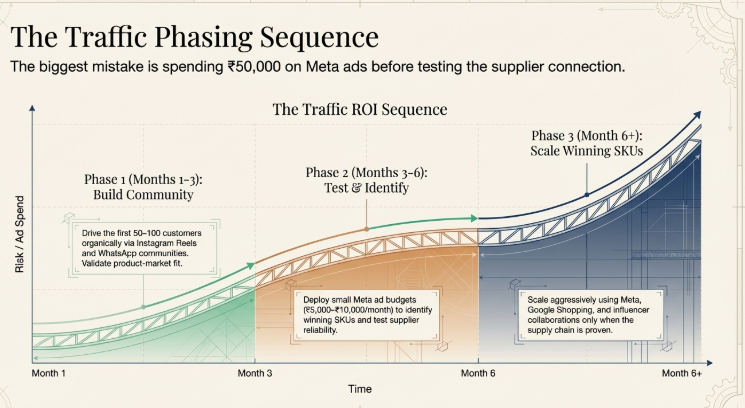
For Indian fashion sellers specifically — the highest ROI traffic sequence is:
Month 1–3: Build WhatsApp community + organic Instagram. Drive first 50–100 customers. Month 3–6: Test Meta ads at small budget (₹5,000–₹10,000/month). Identify winning products. Month 6+: Scale winning products with Meta + Google Shopping. Add influencer collaborations.
This sequence ensures you have proven product-market fit and supplier reliability before spending significantly on paid traffic. Sellers who spend on ads before proving their supply chain consistently lose money.
For sellers who want to maximise their WhatsApp community as a traffic source for their Shopify store — our complete guide on how to build a fashion brand on WhatsApp in India covers the full strategy including automation and broadcast campaigns.
Section 6: Scaling Your Shopify Fashion Store — From ₹50,000 to ₹5,00,000 Monthly
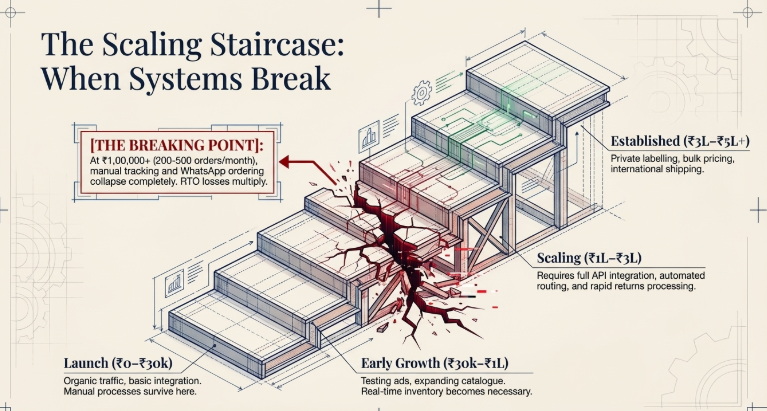
| Stage | Monthly Revenue | Key Actions | Supplier Requirements |
|---|---|---|---|
| Launch | ₹0–₹30,000 | Start with ~10 products, focus on organic traffic, build WhatsApp | Basic integration, fast dispatch |
| Early Growth | ₹30,000–₹1,00,000 | Test ads, expand catalog, collect customer reviews | Real-time inventory sync, automated tracking |
| Scaling | ₹1,00,000–₹3,00,000 | Scale winning ads, add collections, email & WhatsApp marketing | Full API integration, efficient returns handling |
| Established | ₹3,00,000–₹5,00,000+ | Private label, influencer marketing, go international | Private label capability, bulk pricing support |
The jump from Early Growth to Scaling is where supplier quality matters most. At ₹1,00,000+ monthly, you are processing 200–500 orders per month. Manual processes break. RTO losses become significant. Tracking failures become customer service crises.
This is the stage where having a trusted India-based fashion supply chain partner with genuine technology infrastructure — not just a good catalog — determines whether your Shopify store becomes a serious business or plateaus permanently.
About Snazzyway — The Indian Fashion Supplier Built for Shopify Sellers

Snazzyway is India's leading women's clothing and lingerie brand — operating since 2014 with its own manufacturing unit, 4,000+ active seller partnerships, and the Snazzyway Fly cloud-based platform built specifically for seamless supplier integration.
For Shopify sellers specifically, Snazzyway provides:
| Feature | What Shopify Sellers Get |
|---|---|
| Real-time inventory | No out-of-stock surprises on your Shopify store |
| Automated order processing | Orders flow from Shopify to fulfillment automatically |
| Tracking integration | Customers get tracking updates automatically |
| Free pan-India shipping | No shipping cost eating into your Shopify margins |
| Same-day dispatch | Meets Shopify customer delivery expectations |
| 3–7% RTO rate | Protects your paid traffic investment |
| Premium & Plus Size catalog | High-demand, low-competition fashion categories |
| Returns management portal | Shopify return requests handled systematically |
Shopify fashion sellers who want to connect with India's most reliable women's clothing and lingerie supplier can explore our Shopify-compatible fashion supply platform — and start building their Shopify store on a supply chain that is designed for scale.
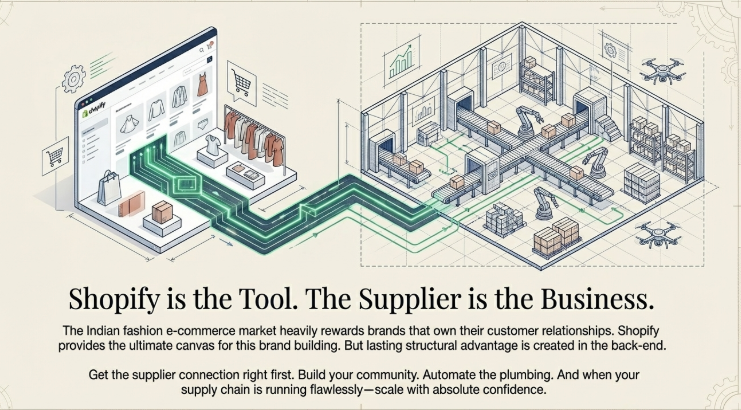
Conclusion: Shopify Is the Platform. The Right Supplier Is the Business.
Building a Shopify fashion store in India has never been more accessible. The platform is powerful, the market is growing, and the tools available to Indian sellers in 2026 make professional brand building possible from anywhere.
But Shopify is a tool — not a business. The business is built by the decisions you make about your supplier, your products, your customer experience, and your marketing.
Get the supplier connection right first. Test thoroughly before spending on ads. Build your WhatsApp community in parallel. And when your supply chain is running smoothly — scale with confidence.
The Indian fashion ecommerce opportunity is real and still growing. The sellers who combine Shopify's brand power with a genuinely reliable Indian supplier are building businesses with structural advantages that marketplace sellers simply cannot replicate.
❓ Frequently Asked Questions (FAQ)
Q1. Can I use Shopify to sell fashion in India with an Indian supplier? Yes — Shopify works excellently for Indian fashion sellers with local suppliers. You need to configure Indian payment gateways like Razorpay, set up COD through a courier integration, configure GST correctly, and connect your supplier through their platform or API. Once set up correctly, Shopify gives you complete brand control with pan-India selling capability.
Q2. How do I connect an Indian fashion supplier to my Shopify store? The simplest method is through the supplier's own seller portal or platform — most established Indian suppliers have digital order management systems that can receive Shopify orders. More advanced integration uses API connections or third-party middleware like Syncee or DSers. Always prioritise suppliers with real-time inventory and automated tracking capabilities.
Q3. What payment gateways work best for Shopify fashion stores in India? Razorpay is the most popular and recommended payment gateway for Indian Shopify stores — it supports UPI, all major debit and credit cards, net banking, and EMI options. PayU is a strong alternative. For COD specifically, you need a separate courier partner integration — Shiprocket is the most widely used for this in India.
Q4. How do I handle COD orders on a Shopify store in India? COD on Shopify requires integration with a courier partner that supports cash collection at delivery. Shiprocket and Delhivery both offer COD services with Shopify integration. You set a COD option at checkout, orders route through your courier partner, and cash is remitted to you on a 7–15 day cycle depending on the courier.
Q5. What RTO rate should I expect from my Indian fashion supplier on Shopify? The national average RTO for Indian fashion ecommerce is 20–30%. For a Shopify store — where you are spending on paid traffic — anything above 10% RTO is seriously damaging to profitability. The best suppliers in India maintain 3–7% RTO through quality control, accurate product representation, and smart COD management.
Q6. Do I need technical skills to connect an Indian supplier to Shopify? Not necessarily. If your supplier has their own seller portal, connecting is as simple as registering and placing orders through their system while managing your Shopify store separately. Full API integration does require technical knowledge or a developer. For most new Shopify fashion sellers, starting with the supplier's own platform and moving to API integration later is the recommended approach.
Q7. How much does it cost to run a Shopify fashion store in India? Basic Shopify plan costs $25/month (approximately ₹2,100). Add Razorpay transaction fees (typically 2%), shipping costs if not covered by supplier, and marketing budget. With a supplier offering free pan-India shipping, your main ongoing costs are Shopify subscription, payment gateway fees, and marketing — making it one of the most cost-effective brand-building options available.
Q8. How does Snazzyway support Shopify fashion sellers in India? Snazzyway provides Shopify sellers with real-time inventory through Snazzyway Fly, automated order processing, tracking integration, free pan-India shipping, same-day dispatch, and an industry-best 3–7% RTO rate. The platform is built specifically for sellers who need supplier-side technology to match Shopify's automation capabilities — ensuring orders flow from store to fulfillment to delivery without manual intervention.
You must login to post a comment.

Related Articles
You may also like these posts
What 10,000+ Reviews Taught Us in 12 Years
Aug 09, 2026
Why We Rebuilt the Snazzyway Review System
Aug 09, 2026
How Snazzyway Works — A Complete Guide for New Dropshipping Sellers in India
Mar 30, 2026
How Snazzyway Has Supported Indian Fashion Sellers for 12 Plus Years
Mar 30, 2026
How Indian Housewives Are Earning ₹30,000 a Month Selling Online From Home
Mar 30, 2026